
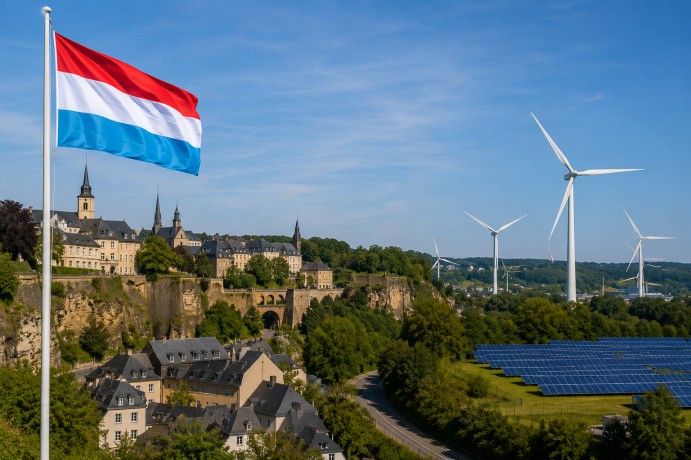
In 2025, Luxembourg found itself among the bottom three European Union countries for renewable electricity consumption, as per Eurostat’s latest figures. Despite a general upward trend in renewable energy usage across the EU, Luxembourg reported that only 20.2% of its gross final energy consumption was sourced from renewables. This positioned the country as one of the lower performers in the union. Specifically, just 23.3% of Luxembourg’s electricity consumption was derived from renewable sources, ranking it above only Czechia and Malta within the EU.
The European Union as a whole demonstrated a stronger commitment to renewable energy, with 26.2% of its gross final energy consumption coming from these sources in 2025. This marks a significant increase from 9.6% in 2004. The EU has set an ambitious target to elevate this share to 42.5% by the year 2030, signaling a concerted effort to transition towards greener energy solutions.
Leading the charge in renewable energy consumption, Sweden emerged as the top performer within the EU, with 65.4% of its overall energy consumption attributed to renewable sources. Closely following Sweden were Finland and Denmark, showcasing their strong commitment to sustainable energy practices. Meanwhile, Austria led the rankings for renewable electricity consumption, boasting over 90% of its electricity being generated from renewable sources.
These statistics highlight the varying levels of commitment and progress among EU nations in adopting renewable energy. While some countries have made significant strides, others like Luxembourg have lagged behind despite the broader EU trend towards renewable energy growth. The data underscores the challenges and opportunities that lie ahead for nations working towards achieving a more sustainable energy future.